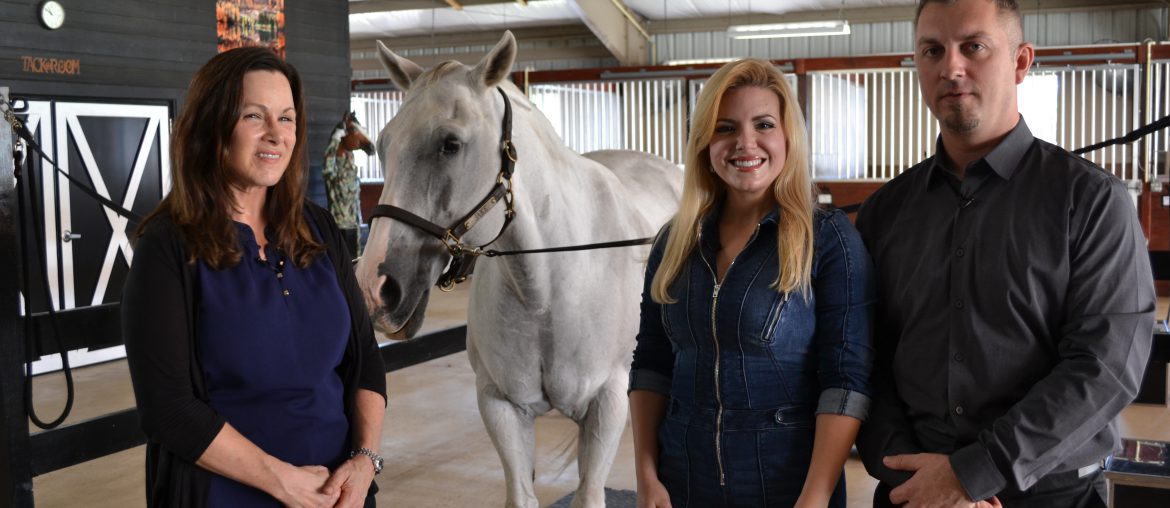
American Medicine Today visited The McCormick Research Institute in St. Cloud, Florida.
The Institute is home to ‘Horses & Heroes,’ a program for veterans suffering from PTSD and ‘Heavenly Hooves,’ another program serving special needs individuals. During the segment, we speak to Dr. Manette Monroe, Professor of Pathology at the University of Central Florida and Director of Research at McCormick Institute, as well as Caity Wall, the ‘Horses & Heroes’ Program Manager. We also hear program success stories from Shemallian “Shemmy” Arrieta, a Second Class Master-At-Arms in the Navy, and a Corporal E4 in the Marine Corps and Francesca Langston, a Corporal in the Marine Corps.
To learn more about The McCormick Research Institute and their equine therapy programs, visit the link here: http://mccormick.us/
Orthopedic surgeon Alfred O. Bonati on ObamaCare, and what he says are the many “lies and problems” that have plagued this flawed policy from its inception. He also addresses the multitude of mishandled issues that have occurred during Mr. Obama’s presidency, including scandals with veterans’ care, security lapses at Benghazi, targeted IRS investigations, and disappointing policies on immigration.
The VA healthcare system has been called “a corrosive culture resistant to reforms and change by Obama’s Deputy Chief of Staff, Ron Nabors.” (Read the publicly released summary of the Rob Nabors report from June 2014 at this link). American Medicine Today Radio spoke to Darin Selnick, Senior VA Adviser of the Concerned Veterans for America (CVA) about the CVA’s Fixing Veterans Health Care Task-force.
Ethan Youker/American Medicine Today host: From 2001-2009, you were an appointee at the Department of Veterans Affairs. You’re also a veteran of the Air Force. You’ve been entrenched with this issue for a long time. What has changed over the years, from when you served under President Bush to now under the current administration?
Darin Selnick, Senior VA Adviser, Concerned Veterans for America
Darin Selnick/Concerned Veterans for America: What’s changed is the leadership and management. Ultimately, it’s a failing system. We had a lot of the problems, and recognized a lot of the problems, and we passed those continuity binders to the Obama folks and they disregarded them. So, we’ve known we needed fixes for a while. When you have really good leadership, you’re able to put a lid on the problems, and deal with a lot of it. New leadership came in, they didn’t listen to anybody, they did untenable things like changing performance measures to stuff that people couldn’t do, and it just caused a collapse to the system, quicker than it would have happened. It would have eventually happened.
Kimberly Bermel/American Medicine Today host: Congressman David Jolly was a guest on our program recently. He mentioned the Choice Card program, which was supposed to alleviate problems, some of which lead to deaths. (Learn about Choice Card .) A Veterans of Foreign Wars report found that only 1 in 5 veterans eligible for the Choice Card were offered the option to get private care outside of the Veterans Affairs Department.
Darin Selnick: 27,000 of the hundreds of thousands of veterans that have tried to do use Choice Card were able to do it. The VFW surveyed its members and only 20% of those that tried could get any access whatsoever. Basically, the Choice Card was considered a Band Aid. — $10 Billion or 2-3 years, whichever ran out first. It was always a “stop the bleeding” approach. But there’s no real choice when you have to ask permission. I knew in the very beginning – and I warned them – that if you give the VA an opportunity to play around with the parameters of getting that choice (such as waiting more than 30 days for VA medical care, or living more than 40 miles away from a VA medical facility), you’re in real trouble.
Ethan Youker: The Veterans Choice card program was supposed to alleviate some of these horrendous wait times. Where did this program go wrong?
Selnick: First, they were very late in issuing the (Choice) Cards. Second, they did rules changes. Congress said “hey do 40 miles and then there are exceptions,” but the VA interpreted it as ‘40 miles from any facility’, not the intent. which was 40 miles from where you needed the healthcare. Then Congress’s recommendation of 30 days from your desired date for an appointment was changed to 30 days from when the VA decided it was medically necessary. For example, when is a colonoscopy medically necessary? You could push it back a year and say you’re still not late. Intent is everything and the VA really didn’t want to let veterans go outside, so it started doing whatever it could. Also, Congress said, “pay Medicare rates, but there’s an exception if you need to.” It (the VA) started paying 30% less. What doctor or health plan is going to be able to accept patients’ 30% less than Medicare rates, which are already lower?
Youker: The Concerned Veterans for America have come up with something called the Veterans Independence Act and it’s supposed to right all of these wrongs that were supposed to be righted in the first place with this program.
Selnick: You need to fix the VA healthcare, and you’ve got to provide choice. If you make it an independent, government-chartered non-profit, accountable, healthcare organization, and not be a monopoly, it will be able to reform itself and make business decisions. Right now it doesn’t control its IT, doesn’t control its personnel, how much money it pays its doctors. It’s got government rates, so it’s got lots of problems. The other thing is offering enrolled choice. Our plan (www.CV4A.org) says if you like your veterans healthcare, you’re close to a facility, and you’re getting good healthcare, you can keep that. But if you don’t like your healthcare for any reason, it’s your choice to leave it. No 40 miles, no 30 day rule. You can be in one or the other. You can pick any healthcare plan in your state.
The Catalyst Refuge is a unique program that teaches relaxation techniques utilizing wild animals to facilitate healing. The program is based at The C.A.R.E. Foundation, a non-profit exotic animal rescue and sanctuary located in Apopka, FL. Catalyst founder Kevin Rose offers the program free to combat veterans, many of whom suffer from PTSD.
Kimberly Bermel/American Medicine Today: Give us some background about why you started this facility?
Kevin Rose/The Catalyst: The Catalyst is a human/animal interaction program that helps people move from feeling totally stressed out to absolutely calm in just seconds. As a massage therapist, I’ve worked with people for more than 20 years, all who have different kinds of stress. I found that there was one variable that brought everyone back to calm within seconds: using the five sense. I developed this program to promote the simplicity of learning to get calm. But the teachers that have been chosen, and have chosen me, perhaps, are the animals. They always live in their senses. They’re always responding to the environment with their senses. They taught me a valuable lesson about how to teach others how to use those inherent tools to calm in seconds.
Dr. Bonati/American Medicine Today: How did you put together the relationship between a person under stress, and an animal?
Kevin Rose: My whole career I’ve been fortunate and privileged to work with animals, as well as people. My first encounter was with dolphins, as a teaching assistant. During class, we were working in the water and swimming with a couple of dolphins. As I was swimming, the dolphins sandwiched me and began following my movements. It was if they were following my thoughts! I was amazed by it. Later, I had the opportunity to work hands-on with wolves. I recognized as I was in the middle of this wolf pack, and my energy raised and lowered, the animals would respond. They would growl and bump me.
Ethan Youker/American Medicine Today: If you’re anxious and upset and feeling aggressive inside, the animals reflect that?
Kevin Rose: That’s right. When I’d calm myself, they would reflect that as well. And that was my introduction to be able to work with the predatory animals specifically. There’s no real filter with them; they respond to the environment and what’s coming towards them. I started working more with them with the intention of bringing other people face-to-face with them to see how they would react. Like clockwork, the animals would react to the stress of that person. I teach this very simple technique that allows you to ground and the animal calms as well.
Ethan Youker: You’ve had a good success rate with soldiers who are diagnosed with PTSD?
Kevin Rose: Yes. It’s been a great time working with them and seeing how they respond to that sensory training. Think about how the universe is based on polarity: I know what hard is, because I know what soft is. When these men and women are trained in this heightened state, they can also know peace at that same degree.
Chris is a Navy Veteran, diagnosed with PTSD, who uses techniques he’s learned through The Catalyst program to center and calm himself.
Chris/Navy Veteran who has trained with Kevin at Catalyst: When I first came to Catalyst, I didn’t have any expectations; I didn’t come thinking these animals are going to react in a certain way. All I knew was to listen to Kevin and go with it. The first time that I stepped up to a cage I felt my shoulders tensing, my stomach began to hurt, I was breathing heavy, my chest was getting tight and my pulse rate was going up. It was all of the things I was familiar with from having a panic attack. The animal started to growl and feed off of my negative energy. I used Kevin’s techniques to calm down and center myself. I immediately saw a reaction in the animals – I could see it in their eyes and in the way they were breathing. I no longer have tunnel vision. When I first came to Catalyst, I didn’t listen to anything. Kevin told me to listen to the birds. Before, I wouldn’t have heard them. It used to be that if I was driving my car, I didn’t hear anything. There was no outside world I was living in, it was just ‘what is right here.’ No, I have the ability to start hearing noises I naturally tuned out for many years. It’s opened my eyes.